
Nurturing Understanding, Inspiring Action
Environmental Education Programme
The BR Hills forest is a living classroom — where learning is experiential and rooted in the landscape itself. Through guided walks, ecological interpretation, and conversations with the Soliga community, the natural world comes alive in ways that endure.
About The Programme
For students, families, and curious minds of all ages
Gorukana’s Environmental Education Programme introduces visitors and student groups to the ecosystems, biodiversity, and conservation challenges of the BR Hills landscape. The programme is rooted in experiential learning — participants engage directly with the surrounding forests, plantations, and natural habitats.
This is education within nature — immersive, grounded, and deeply memorable. Not about the natural world, but within it.
The programme draws on the TEK of the Soliga community — a sophisticated, place-specific understanding of the forest built through centuries of direct observation, increasingly recognised by conservation scientists worldwide as an invaluable resource in biodiversity conservation.
Learning Activities
Three pillars of the Environmental Education Programme
Ancient Knowledge
Living Knowledge
The Soliga community’s songs, stories, and traditional ecological knowledge are a living record of the BR Hills forest – its seasons, plants, animals, and sacred places. At Gorukana, this ancient wisdom is shared directly by the people who hold it.
Programme Details
- Soliga Cultural Programme — songs and stories as ecological knowledge
- Traditional Ecological Knowledge — medicinal plants, wildlife, seasonal cycles
- Direct engagement with Soliga community members
Whispering Forest
The Forest Walk
The BR Hills forest is best read on foot. Guided by Soliga community members, participants explore the landscape — identifying trees, birds, and the ecological relationships that hold this ancient forest together.
Programme Details
- Guided nature walks in the BRT Tiger Reserve landscape
- Bird watching — kingfishers, hornbills, parakeets, bulbuls
- Tree trail — identifying local flora and ecological relationships
- Wildlife observation and habitat conservation
Open Classroom
Roots & Cycles
How the natural world works — experienced through hands-on workshops, ecological demonstrations, and the act of planting a tree in the BR Hills forest. Learning that stays long after you leave.
Programme Details
- Eco-practices demonstrations — composting, water conservation
- Workshops — water cycle, nitrogen cycle, food web
- Soil and water conservation practices
- Tree planting and habitat restoration
- Community clean-up drives
IMPACT ON PARTICIPANTS
- A Deeper Understanding of Nature — You leave with a genuine understanding of ecosystems, biodiversity, and what conservation actually means on the ground.
- A Personal Connection with the Landscape — Experiential learning creates a relationship with the natural environment that stays with you long after you leave.
- The Confidence to Act — Greater awareness inspires real change — in daily habits, in choices, and in support for conservation.
- Part of a Larger Community — You become part of a growing network of individuals and groups actively engaged in environmental awareness and stewardship.
At Gorukana, environmental education is not a programme you attend — it is an experience you carry with you. The forest, the community, and the landscape do the teaching. You simply need to show up and pay attention.
What you find here is not information — it is understanding. The kind that comes from standing in a forest at dawn, walking with someone who has known it all their life, and slowly realising that the web of life is not a concept. It is the ground beneath your feet.
The Soliga community has known this for centuries. That knowledge is part of what you learn here.
AMRUTAVANA – tHE hEALING gARDEN
Medicinal Plants, Traditional Knowledge & Wellbeing
Amrutavana is Gorukana’s living collection of medicinal plants, bringing together species valued for their healing properties and cultural significance. The garden showcases herbs, shrubs, climbers, and trees used in Ayurveda and other traditional knowledge systems, offering opportunities to learn about the relationship between plants, wellbeing, and the natural world.
Many of the plants in Amrutavana are woven into the Soliga community’s Traditional Ecological Knowledge — knowledge shaped by generations of living with, learning from, and caring for these forests. Through close observation of the landscape, the Soliga community has developed a deep understanding of the medicinal, ecological, and cultural relationships that connect people and plants.
As a living classroom, Amrutavana encourages exploration of plant diversity, traditional knowledge, conservation, and the role of medicinal plants in supporting both human and ecological wellbeing. It offers a unique window into the ways nature, culture, and healing remain interconnected.
Young Explorer – Nature Awareness Programme
Young Explorer — Nature Awareness Programme brings the Environmental Education Programme to children below 12 years, guided by members of the Soliga community.
Every child who completes the programme receives a Young Explorer Certificate of Participation, a personal acknowledgement of their journey through Gorukana’s living classroom.
The programme is offered in two experience formats:
Immersive Experience – for school & student groups
A structured environmental learning experience for school and student groups, guided by Soliga community members along with a facilitator/interpreter, through forest walks, ecological activities, cultural interactions, workshops, and outdoor learning experiences rooted in the programme’s three pillars.
Participants receive a Young Explorer Certificate – Immersive Experience.
Discovery Experience – for young guest staying at Gorukana
Children below 12 years staying at Gorukana with their families can register upon arrival for a guided nature discovery experience with a Soliga community member. Through forest walks, bird and tree observation, and outdoor nature-based learning, children are encouraged to explore, observe, and connect with the natural world of BR Hills.
Participants receive a Young Explorer Certificate – Discovery Experience.
(Note: The experience is conducted by a Soliga community member in Kannada. Interpretation services are not available.)
Speak to our team at the front desk to register. (Registration form available at the Gorukana reception)
For students, families, and curious minds seeking meaningful experiences in nature.
The Nature Awareness Programme at Gorukana is a living classroom experience, guided by the Soliga community in the BRT Tiger Reserve, BR Hills. Enquiry Now: enquiry@gorukana.org | +91 63607 47973Megalithic Heritage of the BR Hills
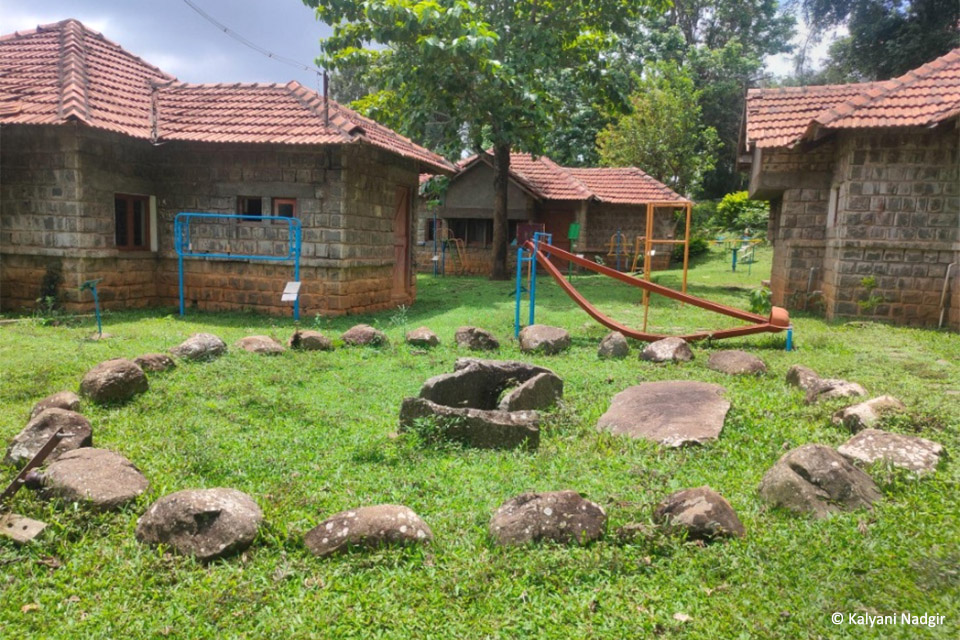
A dolmen discovered locally, which was reorganised for public display at the Vivekananda Girijana Kalyana Kendra (VGKK) campus, BR Hills.
The megalithic burial sites at BR Hills, Karnataka, India, are remnants of ancient civilizations dating back to the Iron Age — around 1000 BCE to 500 CE. These sites, characterized by structures like dolmens, menhirs, cairns, and stone circles, offer valuable clues about burial practices and social structures of ancient communities.
Excavations have uncovered pottery, tools, weapons, and human remains — providing significant archaeological insights. Beyond their historical importance, these sites serve as living educational resources, enriching our understanding of human history in this ancient landscape.
Beyond their historical and cultural importance, these sites serve as educational resources, offering opportunities to learn about prehistoric life and societies. They stand as enduring windows into the past, enriching our understanding of human history and evolution.